
Abandoned cart email sequence
Examples, logic and decisions for a relevant, measurable abandoned cart sequence that does not always rely on discounts.
 By Dídac Anton
An abandoned cart and an abandoned checkout are different events
Adding a product to a cart expresses interest. Starting checkout is a later step. If both behaviours sit under a single “abandoned cart” label, you may send a message that assumes the customer has provided information or made decisions they have not actually made. Before designing a recovery sequence, identify the event that really starts it.
Klaviyo distinguishes Added to Cart from Started Checkout. Many recovery templates use the latter. Available tracking depends on the integration and on whether activity can be associated with an eligible profile. Inspect a real event before building the email: a name on a diagram does not prove your store is collecting it.
Someone who only views a product page is in a different situation. Browse abandonment lets you respond to that interest when identification and sufficient data are available, but the message should not imply that an order was left unfinished. The more precisely you understand the observed behaviour, the more relevant your help can be.
| Situation | What you know | What you should not assume | Message focus |
|---|---|---|---|
| Product viewed | Interest in a product page, if the event was recorded | That a cart exists or the person is ready to pay | Help the person understand or choose the product |
| Product added | An item was added to a cart | That checkout information has been supplied | Recall the selection and make it easy to return |
| Checkout started | The person moved into the purchase process | That you know why they left | Provide a way back and answer questions you can substantiate |
| Order placed | A purchase exists according to the received event | That recovering this checkout is still appropriate | Stop recovery and review the post-purchase journey |
Check the data before sending
Review how the person, event and products are connected. The email needs to show the correct selection, link to the right destination and respect the contact’s marketing status. Copying a dynamic block from another flow can produce a message that looks convincing in the editor but renders empty when a different event supplies the data.
Prepare a test record containing the event date, items, variants, language, currency and available recovery link. These fields are not identical across platforms. If a variant disappears or a price changes, decide how your team will check that the email and store remain consistent. Customers should not discover different conditions only after clicking.
Purchase history can also change the conversation. A returning customer does not need the same introduction as someone who has just subscribed. Segmentation by purchases and interest helps identify useful differences; there is no need to create a branch for every data point when the branches ultimately send the same content.
Build the sequence around real customer questions
The first message can simply recall the selection and offer a route back. Do not invent a reason for abandonment: “Your payment failed” only makes sense when you have data confirming that failure. Someone may also be comparing products, dealing with an interruption or postponing a decision. Leave room for those possibilities in the copy.
For later messages, draw on questions your store can answer accurately: sizing, compatibility, materials, delivery times or exchange conditions. As an educational example, a footwear store could link a fit guide beside the selected model. It does not need to invent scarcity or claim that a product is reserved when it is not.
If you consider an incentive, evaluate its purpose and cost. Does it address a specific barrier? Can it be combined with other promotions? Does the resulting order still make commercial sense? Discounting every abandoned cart may encourage customers to wait for another offer. That is a business hypothesis to investigate, rather than a reason to rule out all discounts.
The email’s layout should support that decision. A recognisable product, a short explanation and a clear link can be more useful than several competing blocks. Our guide to email copy and design explains how to align the subject line, visual hierarchy and destination without turning every message into a catalogue cover.
Choose timing and message count with a clear purpose
No delay is optimal for every store. A quick purchase and a product that requires comparing measurements involve different decision processes. Klaviyo’s documentation also makes clear that cadence needs to be assessed in the context of the business. Treat any prebuilt sequence as a starting point that needs adjustment.
For each send, write down what it adds beyond the previous one. If there is no clear answer, it may simply repeat commercial pressure. The final number should follow from the jobs the messages need to do, the signals available and the audience’s response. Longer sequences also require more maintenance when products, offers or policies change.
Review the combined sending calendar. A person might be receiving a welcome sequence and a campaign while abandoning checkout. Decide which message takes priority and which should be delayed or skipped. Document that coordination so it does not depend on someone remembering every automation whenever a campaign is scheduled.
Stop recovery when the customer’s situation changes
In Klaviyo, a filter checking that no order has been placed since entering the flow can prevent continuation after a purchase. Test the actual configuration alongside the store’s synchronisation timings. An initial filter alone is insufficient if the rest of the journey does not reassess the conditions needed to send.
Check whether the store platform’s native recovery, an old app or another flow is handling the same abandonment. Before disabling one, identify the messages it covers and validate its replacement. Each send should have a clear owner, avoiding an accidental gap in coverage or two equivalent reminders.
After conversion, the conversation can move into the post-purchase sequence. Asking for a first purchase just after it has happened makes the journey inconsistent. Also define what happens when an event repeats, the cart changes or a person unsubscribes. These operational conditions can matter more than adjusting the final message’s subject line.
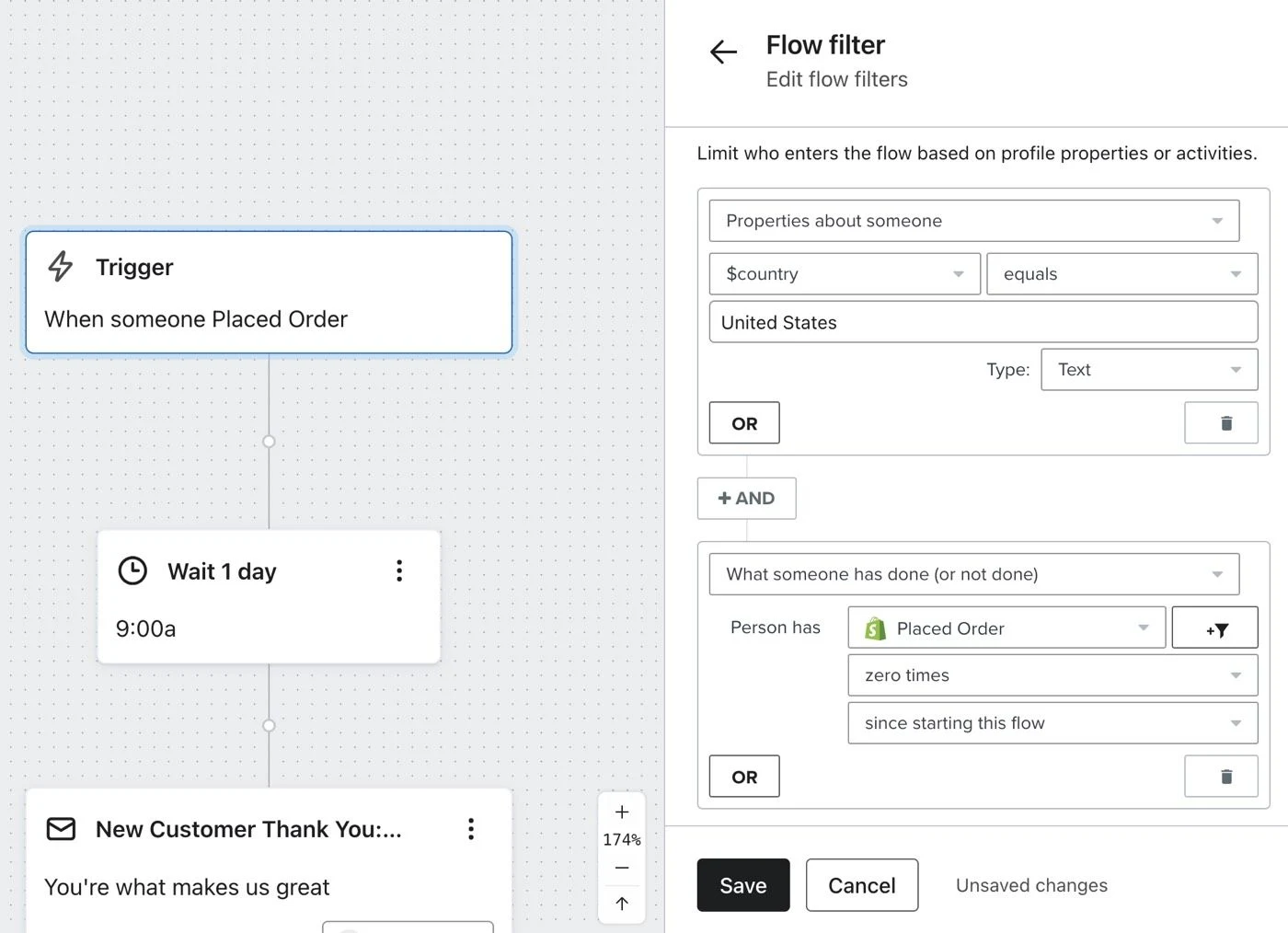
Reproduce the complete abandonment journey
Use a test contact and record the expected outcome at each stage. Generate the activity in the store first, then confirm that the event, products and identity arrived correctly. Continue through the email link and verify its destination. Finally, complete the purchase and check what happens to the remaining messages.
Testing should reflect the important cases in your catalogue. If you sell variants, use a specific variant. If you work across languages or currencies, confirm that the email and checkout preserve the selection. Keep enough evidence to repeat the checks when the integration changes.
Acceptance scenarios
- Eligible abandonment: the correct product appears and the link allows the customer to resume purchasing.
- Later purchase: reminders that are no longer relevant stop sending.
- Repeated event: incompatible journeys do not accumulate for the same customer.
- Changed or unavailable product: the message does not promise conditions the store cannot fulfil.
- Ineligible contact: the journey respects the recipient’s status.
- Two active systems: the sender of each reminder is identified and duplication is removed in a controlled way.
Interpret recovery results in context
Review flow entries, messages sent, clicks, attributed orders and unsubscribes, but first define the reporting period and denominator. Comparing orders with checkouts differs from comparing buyers with recipients. The email marketing KPI guide helps separate those interpretations.
An increase in attributed revenue may coincide with more traffic, price changes or a promotion. It does not automatically mean that the new sequence caused additional sales. Record the attribution settings and business conditions before drawing conclusions. If you test an incentive, include its cost and avoid deciding on revenue alone.
A useful review ends with a specific decision: retain a message, change its explanation, simplify a branch or investigate an event. Address failures affecting the whole journey before optimising details of an individual email. A subject line that earns more opens cannot compensate for a broken recovery link.
Sources and further reading
AI-assisted translation
Article by Dídac Anton. The English, German, Dutch and French versions were translated from Spanish with the help of AI.
Read the Spanish originalRecommended articles
Ecommerce welcome email sequence
Design a welcome journey that delivers on the signup promise and reflects each subscriber’s actual customer stage.
Browse abandonment email flow
Design browse abandonment messages using valid signals, identified users and rules that prevent overlap.
Post-purchase email sequence
Connect the post-purchase experience to useful information, reviews and future purchases while respecting the real order status.