
Post-purchase email sequence
Connect the post-purchase experience to useful information, reviews and future purchases while respecting the real order status.
 By Dídac Anton
After a purchase, the customer’s needs change
Someone who has just paid no longer needs persuading to place that same order. They need to understand what happens next, use their purchase successfully and find help if something is wrong. A post-purchase sequence organises that conversation. Another sale can be part of it, but does not have to be the purpose of every message.
Start with a simple question: what uncertainty arises between payment and the first satisfactory experience with the product? The answer depends on the catalogue. Clothing may need care guidance; a technical accessory may need a compatibility check; a consumable may need storage information. That creates a specific reason to write.
Customer retention requires connecting the store’s promise with the experience after purchase. This article proposes a method for choosing messages, timing and exit conditions. The examples are educational: they do not represent client results or a sequence to copy without checking the underlying data.
Distinguish an order from shipping and delivery
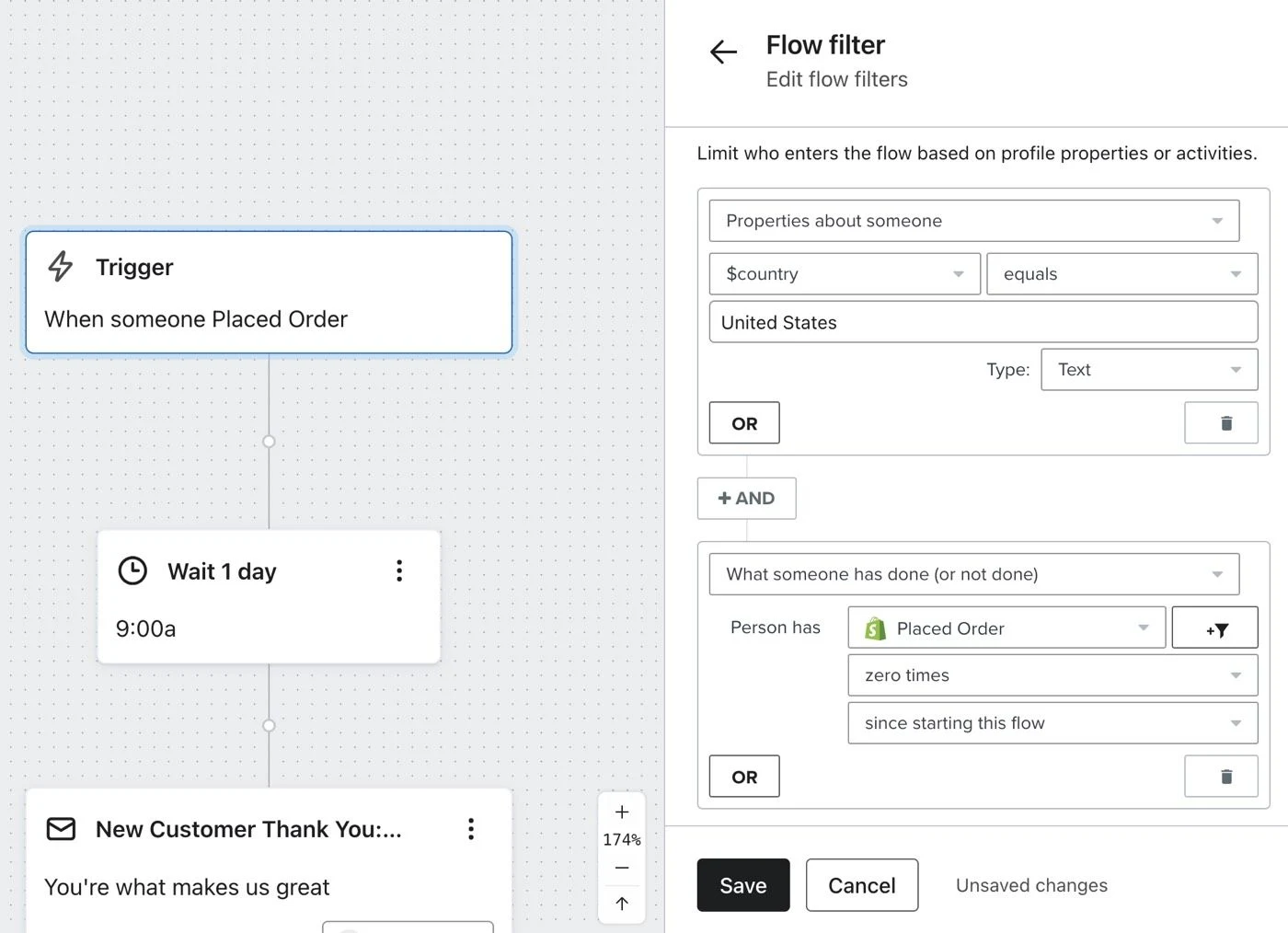
Klaviyo supports starting a post-purchase flow with Placed Order. That event confirms an order, not physical receipt of the product. The content needs to respect the difference. If the store has no reliable delivery signal, a message should not claim the customer already has the parcel.
Map the states your team can genuinely observe. Then distinguish messages requiring confirmation from those that can help while the customer waits. A care guide can be presented as preparation; a request to review the product’s use needs a reasonable opportunity to try it first.
The following table is a planning proposal. Its purpose is to reveal dependencies, rather than prescribe a universal number of days for each stage. When a signal is missing, change the wording, wait or leave that part out until the missing information is resolved.
| Stage | Customer’s question | Potentially useful content | What to check first |
|---|---|---|---|
| Order recorded | What have I bought, and what happens next? | Guidance and a clear route to help | Order status and consistency with the existing confirmation |
| Preparation or transit | Where can I find useful information? | Guidance before use or care | The wording does not assume an unconfirmed delivery |
| Product received and used | Am I using it correctly? | Specific instructions and answers to questions | A realistic opportunity to use it and no conflicting unresolved issue |
| Enough experience | Can I share how it went? | A neutral invitation to leave feedback | The correct product and review destination |
| A new need | Which accessory or replenishment makes sense? | A recommendation related to the purchase | Compatibility, availability and subsequent purchases |
Give each communication a clear job
Inventory the messages a buyer already receives: order confirmation, logistics updates, carrier notifications, support communications and marketing emails. Record which system sends each one and who maintains it. Without that inventory, it is easy to add a thank-you that repeats a confirmation or a promotion that arrives during an unresolved problem.
When planning, treat operational information and commercial offers as different needs. A purchase does not make every later message appropriate. Review eligibility for each communication and preserve a clear way out. If you need to establish a message’s formal classification, check it with the platform and whoever manages compliance for the store.
Coordination also concerns messages from before the purchase. Check that cart and checkout recovery stops requesting an order that has already been placed. If a welcome sequence continues, decide which parts still help the new buyer. The messages should make sense as a coherent conversation when read together.
Example: supporting a clothing purchase
Imagine a store selling linen clothing that wants to reduce uncertainty about use without turning post-purchase communication into a stream of offers. The team reviews customer service questions and finds two recurring themes: how to wash a garment and what to expect from its texture after initial wear. These questions justify specific content.
A first email could use the subject line “Caring for your new linen garment”. Inside, a short introduction would link to verified instructions for that item. The call to action might be “See the care guide”. The store must use the manufacturer’s actual instructions; this example describes a message structure, rather than textile advice that applies to every product.
Later, after an opportunity to wear the garment, a message could ask for feedback neutrally: “How did your order work out?”. The response should lead to a monitored channel or a suitable review page. Do not ask exclusively for a positive review or make feedback a requirement for receiving help.
A third communication could show an accessory that works with the garment. Explain the relationship through fabric, use or an outfit, for example. Changing only the heading and showing everyone the latest products is not a purchase-based recommendation. Copy and design should make the connection understandable without filling the email with blocks.
The three pieces do not have to belong to one flow. What matters is that they have compatible entry and exclusion rules, clear ownership and a reason to exist. Separating them by purpose may make maintenance easier when a guide changes or a product family is no longer available.
Segment when it changes the help you provide
Before adding a branch, write down the different message each group will receive. A first-time buyer may need context on contacting the store; a returning buyer may not. Two products may require different instructions. By contrast, splitting on a data point that changes neither content, timing nor eligibility adds work without a clear benefit.
Klaviyo documents product-specific flows. For editorial planning, that means checking the item or category that justifies each instruction. Knowing that a profile has bought something at some point is insufficient: the message needs to relate to the right purchase and product.
Document the relationship between products and content in a small operational catalogue: product family, linked guide, owner and review date. That makes it easier to identify what happens when an item is introduced or instructions change. Customer segmentation is easier to maintain when every rule has a visible consequence and someone can explain it.
Also distinguish accessories from replenishment. A durable item may create interest in accessories, whereas a consumable may need replacing. Timing should come from business signals and expected use, rather than a delay borrowed from another sector. If the person buys again, check whether a pending recommendation still makes sense.
Plan exceptions before activating the sequence
Consider what someone would read if their order were delayed, cancelled or returned. A message celebrating product use may feel disconnected from that experience. Decide which signals your system can receive and which messages should stop or change. If a problem exists only in a support conversation, do not assume the flow knows about it.
Prepare a validation record containing the order, products, language, known status and expected result. Have someone on the team follow the entire case, from the input data to the linked page and subsequent support. A preview helps review an individual piece; testing the journey confirms whether it arrives in an appropriate situation.
Maintenance deserves as much attention as launch. Changing a returns policy, guide or support URL can make several messages outdated. Assign review to the person who understands those conditions and record which pieces depend on them. An email marketing audit can organise those dependencies before adding new automations.
Scenarios worth testing
- First purchase: the wording acknowledges the purchase and shows the correct product.
- Repeat purchase: the customer is not addressed as though they have never bought before.
- Delayed order: the content does not claim the customer already has the product.
- Cancellation or return: pending messages that no longer fit are reviewed.
- Another purchase during the sequence: the system does not suggest replacing a newly purchased item without a valid reason.
- Different language or variant: the guide and destination match the selection.
- Customer reply: it reaches a monitored channel rather than an unattended inbox.
Measure the experience and the next decision
Do not judge every message by a single sales metric. A guide may aim to help customers find instructions; an accessory recommendation seeks a compatible purchase; a feedback request expects a response. Define which signal can assess each purpose and what that signal cannot tell you.
To study repeat purchasing, compare groups with similar opportunities to buy again. A cohort that has just received its orders has not had the same observation time as a much older cohort. Keep the period, customer definition and denominator clear. The email marketing metrics guide explains how to avoid comparisons that look precise but answer different questions.
No new purchase does not automatically call for another immediate offer. It may reflect the normal product cycle. When a relevant period passes without a response or purchase, customer winback addresses a different stage with its own criteria. Post-purchase and winback communication should connect without repeating the same promise indefinitely.
End each review with a verifiable improvement: correct a guide, adjust a destination, remove a repeated message or change an exclusion. The value of this sequence lies in useful help after payment. More emails are only useful when that help improves.
Sources and further reading
AI-assisted translation
Article by Dídac Anton. The English, German, Dutch and French versions were translated from Spanish with the help of AI.
Read the Spanish originalRecommended articles
Abandoned cart email sequence
Examples, logic and decisions for a relevant, measurable abandoned cart sequence that does not always rely on discounts.
Win-back email campaign
Build winback around the repurchase cycle and customer context, not one fixed delay for the entire list.
Ecommerce email flows
A practical guide to selecting, connecting and prioritising email flows by customer stage and available data.