
Ecommerce email segmentation
Turn segmentation into useful rules for deciding what to send, to whom, when and why.
 By Dídac Anton
Segmentation starts with a different decision
A segment earns its place when it changes a decision: what to explain, which product to suggest, when to contact someone or when to stop. Splitting a database into numerous groups does not improve email marketing by itself. If every group receives the same message, offer and frequency, the classification creates work without a clear purpose.
Start with a specific question. Who needs help using their first purchase? Then identify the information that answers it and the appropriate communication. This order avoids creating labels such as “interested” or “VIP” before agreeing what they mean and what each group should receive.
When planning campaigns, put an audience statement, an exclusion and a reason for sending beside the subject line. If you cannot explain why someone should receive that message today, revisit the selection before designing the email.
Lists and segments serve different purposes
Klaviyo distinguishes lists with added members from segments defined by conditions. Segment membership changes as profiles meet or cease to meet those conditions.
As a practical organisation method, use a list to manage acquisition for a channel and segments for operational questions: recent buyers, category interest or people needing follow-up. Do not create another list every time you want a different campaign; first consider whether a reusable rule answers the question.
A fixed audience snapshot and a dynamic audience also answer different questions. To analyse what happened to people selected on a particular date, retain that selection. To decide who needs a reminder now, evaluate their current circumstances. Confusing the two can silently change the population behind a report.
Permission is separate from commercial interest
A purchase, product visit or list membership should not automatically become permission for a marketing campaign. Check the relevant subscription, its origin and current validity, unsubscribes and exclusions separately. A group may be useful for analysis without being an audience you should contact.
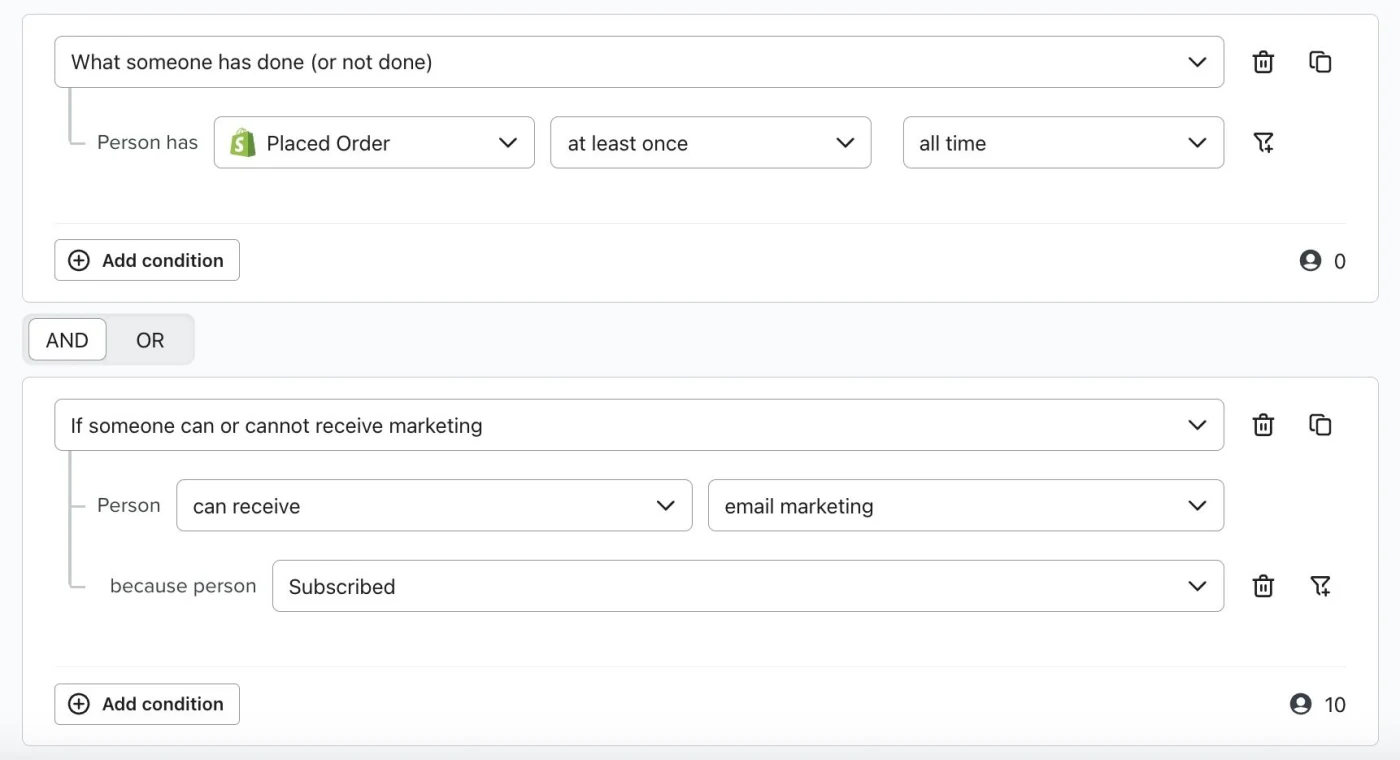
Klaviyo’s conditions reference distinguishes being able to receive marketing from filtering specifically for subscription. Check the precise channel condition in your account.
Use two independent checks: commercial relevance and permission to communicate. A sending audience must pass both. Do not connect those checks with “or”, which would allow interest to replace permission. Similarly, do not reuse an email subscription as permission for a different channel.
If information is missing, mark it for review instead of interpreting a blank field as agreement. A welcome sequence should respect the promise and circumstances of signup; an old import needs its own review before being treated as a new subscription.
AND, OR and grouping: test who belongs
Klaviyo documents AND for requiring every condition and OR for accepting alternatives. The following is a fictional logic example, not a universal configuration for the platform.
A shop wants to contact eligible subscribers who bought coffee or stated an interest in coffee. Let P mean eligibility, C a purchase and I declared interest. The intended rule is P AND (C OR I). If your builder cannot express that group directly, write both complete branches: (P AND C) OR (P AND I).
| Fictional profile | P / C / I | Expected result |
|---|---|---|
| Anna | Yes / Yes / No | Included through purchase and eligibility. |
| Ben | Yes / No / Yes | Included through interest and eligibility. |
| Cara | No / No / Yes | Excluded: interest does not replace permission. |
| Daniel | Yes / No / No | Excluded: the defined relevance is missing. |
To exclude two categories, require “not A AND not B”. With “not A OR not B”, somebody in A can qualify because they are not in B. Always test somebody satisfying each branch, somebody satisfying neither and somebody who must stay excluded despite showing interest.
Five useful segments with rules to adapt
These recipes are proposed working definitions. Every one still needs the eligibility check above when used to send marketing. Before implementing them, define a valid order, the treatment of cancellations and returns, and the history available for analysis.
| Group | Proposed commercial rule | Decision and exit |
|---|---|---|
| First-time buyer | Exactly one valid order in the defined history. | Offer help using the product; leave this group after a second valid purchase. |
| Repeat buyer | At least two valid orders in that history. | Recognise previous experience; check category and recent purchases before making an offer. |
| VIP | An agreed value and purchase-frequency threshold within a declared window. | Provide a specific benefit; reassess after purchases, returns or changes to the window. |
| Inactive customer | A previous purchase, with no repeat purchase beyond the defined buying cycle. | Consider winback; exit after a purchase or loss of eligibility. |
| Category interest | A stated preference or relevant, recent, identifiable signal. | Provide related content; reassess after purchases, preference changes or signal expiry. |
“No recorded orders” does not always mean “never purchased”: migration history may be incomplete. Record that limitation. For VIP, distinguish gross spending from value after returns. Choose a definition you can calculate and explain, rather than an impressive amount unrelated to the business.
Inactivity depends on category and elapsed time
Fictional example: a shop sells coffee and coffee machines. It proposes reviewing a possible coffee replenishment need after several weeks, but does not expect a machine buyer to need another machine that soon. Actual intervals should follow the product, its use and purchase history; this example does not prescribe a sending schedule.
One person may buy both categories. Decide whether the question concerns their overall relationship with the shop or a particular product. Buying accessories might interrupt a general winback sequence without resolving a coffee replenishment need. Document the event that changes each group.
For customer retention, examine categories and cohorts with comparable observation time. A single average can conceal distinct behaviours. A winback sequence should start when there is a defensible reason to consider the relationship in need of attention, rather than after one fixed interval across the entire catalogue.
Membership of two groups does not require two emails
A repeat buyer can also be a VIP, interested in a category and in the middle of checkout. These segments describe different dimensions. They need not be mutually exclusive for analysis, but their interaction must be resolved when communications are scheduled.
One proposed priority is to address the most recent situation that changes the message. A completed purchase makes a reminder for that checkout inappropriate; an unresolved support issue may justify pausing a promotion. Then consider scheduled campaigns and overall contact pressure. Do not turn this proposal into a rigid hierarchy without checking the shop’s objectives.
In the automation map, record which journeys each sequence can replace, what stops it and who maintains the rules. Deduplicating one campaign does not prove that separate campaigns and flows are coordinated. Check the complete experience of the same profile.
Do not define interest through opens alone
Klaviyo identifies opens associated with Mail Privacy Protection. That signal cannot reliably distinguish a human reading the message from an automatic open.
It also documents bot clicks generated by automated systems. A recorded click alone does not establish purchase intent.
For analysis, combine coherent, recent signals: expressed preferences, identified browsing, orders and message responses. Each has limitations. Missing browsing activity might reflect missing tracking; a gift purchase does not establish permanent interest in a category.
Keep the definition of engagement you used and record changes to filters. If a segment changes size after you alter the treatment of automated activity, do not describe it as a sudden loss of interest. The email marketing metrics guide helps separate measurement changes from behavioural changes.
Validate sample profiles and transitions before sending
Review profiles that should qualify and profiles that should be excluded. A plausible total is not enough. Check the date, event, property and condition explaining each membership decision. Keep test profiles separate from commercial campaigns.
In a controlled environment, simulate relevant changes: a second purchase, an unsubscribe, a new preference and an expiring time window. Check when each change becomes visible. Do not assume instantaneous updates or that an audience scheduled earlier always preserves the same state until delivery.
- Test every OR branch and the combined requirements of AND conditions.
- Include blank properties, incomplete history and a date exactly on the time-window boundary.
- Confirm that an unsubscribe prevents delivery even if the profile remains commercially relevant.
- Check the transition from first-time to repeat buyer and exit from winback after a purchase.
- Review somebody appearing in both a campaign and an automation for duplicate contact pressure.
If a sample contradicts the written rule, correct the definition or data first. Increasing sending volume will not solve a selection error.
Keep rules understandable and give them a review date
Maintain a record for each segment: purpose, owner, definition, data source, time window, exclusions, dependent campaigns or flows and latest review. Its name should identify the decision; technical detail belongs in the record. Another person can then maintain it without reconstructing the original intention.
Review after integration, catalogue, permission or measurement changes and at intervals appropriate to its use. Investigate unexpected increases or decreases. Before deleting an apparently outdated segment, check its dependencies and whether another message uses it as an exclusion.
Evaluate segmentation by the decisions it improves: message relevance, journey consistency and interpretable results. Do not promise additional sales simply from dividing the database. If a group is too small to support a conclusion, retain that uncertainty and simplify the experiment instead of manufacturing an explanation.
Sources and further reading
AI-assisted translation
Article by Dídac Anton. The English, German, Dutch and French versions were translated from Spanish with the help of AI.
Read the Spanish originalRecommended articles

Ecommerce email marketing KPIs
Understand what each KPI measures, how to calculate it and how to use it without confusing attribution with incremental impact.
Ecommerce email flows
A practical guide to selecting, connecting and prioritising email flows by customer stage and available data.
Ecommerce welcome email sequence
Design a welcome journey that delivers on the signup promise and reflects each subscriber’s actual customer stage.