
Ecommerce email marketing audit service
Find issues and opportunities through an audit that ends with prioritised decisions, not a generic list of tips.
 By Dídac Anton
An audit should help decide what to fix first
An email marketing audit reviews how contacts are acquired, how recipients are selected, which messages are sent and how results are interpreted. Its value lies in turning observations into decisions: what works, what needs correction and what cannot yet be concluded.
Start with the question behind the review. Perhaps a flow stopped sending, unsubscribes increased or the team cannot explain differences between reports. A specific objective helps select evidence and distinguish a single incident from a broader channel review.
Before starting, agree whether the delivery is a limited review, a diagnosis of particular journeys or a wider audit. Also define whether implementing corrections is included. The team then knows what to expect and who owns the next steps.
Agree scope, access and samples
The inventory should include the email platform, store, integrations and tools sending similar messages. Request named access with permissions appropriate to the review; use read-only access where sufficient. Avoid sharing credentials or exporting personal data unnecessary to explain a finding.
Define the analysis period and pieces to be reviewed. Sampling can be useful, but should be identified as such: reviewing a few emails does not establish that every journey works. This table suggests areas to include in scope.
| Area | What to review | What may limit the conclusion |
|---|---|---|
| Acquisition and data | Forms, contact status and fields used | Incomplete history or a recent integration |
| Audiences | Segments, exclusions and actual recipients | Rule changes without a record |
| Automations | Events, conditions, delays and messages | Missing real cases or test data |
| Campaigns and content | Proposition, links, terms and coordination | Content checked only as a sample |
| Deliverability | Authentication, bounces, complaints and trends | Missing access or provider signals |
| Measurement | Metrics, periods and attribution rules | Configuration changes or incomparable sources |
If message reception is the main issue, specify a deliverability review. If the customer journey is affected, prioritise automation rules. Scope should follow the observed problem.
Each finding needs reproducible evidence
Record where the problem appears, when it was observed and under which configuration. A screenshot without context may show a symptom without making it reproducible. Include the piece identifier, reporting period and steps needed to find the evidence again.
Separate facts from hypotheses. “The link leads to a missing page” can be checked directly. “That error explains the sales decline” needs more evidence. Preserve that distinction so a technical observation does not become an unsupported commercial conclusion.
When using a profile as an example, retain only necessary information and avoid exposing personal details in the shared report. Describe the behaviour, event and relevant condition. The aim is to let the team review the case, not multiply copies of customer data.
Also record what could not be checked. Pending access, an integration without history or a piece that has already changed should be listed as limitations, alongside the information needed to resolve them.
Example of a report that leads to specific actions
The fictional sample below explains the format of a finding. It does not describe issues discovered in an Abalola account or promise financial impact. Priority comes after assessing scope, certainty and consequences.
| Example observation | Evidence to attach | Proposed action | Closure criterion |
|---|---|---|---|
| A button leads to a retired collection | Source URL and destination response | Update the link in the active piece | The received link reaches the approved collection |
| Copy shows an unresolved variable | Test with missing data and email version | Define fallback content and check implementation | Profiles with and without data receive complete text |
| A reminder arrives after a purchase | Event timeline and sequence rules | Review the condition controlling subsequent sending | A purchase during the delay behaves as agreed |
| Two reports use different periods | Dates, timezone and both configurations | Align the comparison and document its limits | The comparison identifies period, metric and source |
“Review the flow” is too open-ended as a final task. A useful recommendation identifies the piece, proposed change, owner and test that will establish resolution.
Not every skipped message is an error
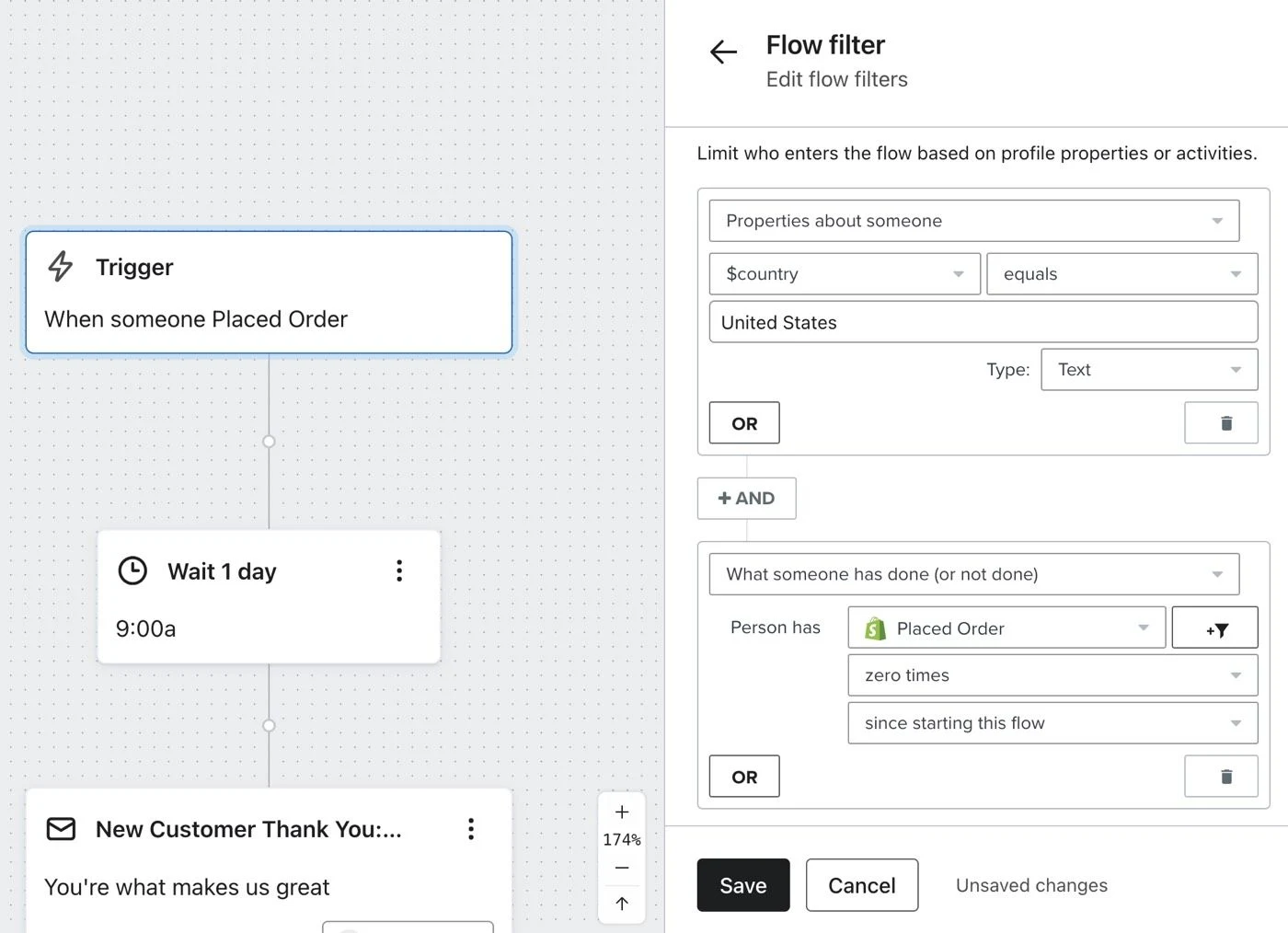
Klaviyo recipient activity shows skip reasons, including filters, suppression and sending errors. Check the specific reason before concluding that an automation is broken.
A reminder that stops after a purchase may be doing its job. A message that cannot be generated because data is missing needs a different investigation. Counting those situations together hides the distinction between an intended exclusion and a fault.
Reconstruct the timeline: which event occurred, when it reached the platform and which conditions were evaluated. Also check whether the message was active and whether another tool sent something similar. Changing a rule without understanding that timeline can move the problem elsewhere.
Klaviyo supports previews and test emails with profile or event data. Use that check to inspect the case’s content, then complete the review with actual journey activity.
Prioritise consequences, evidence and dependencies
A lengthy report is not useful if every recommendation seems equally urgent. Distinguish issues affecting recipients or commercial terms, measurement obstacles and improvements needing a hypothesis. Explain each priority in language the team can verify.
Consider dependencies too. Correcting copy may use existing resources; verifying an event may require the store’s technical team. The plan should allow progress while identifying what blocks each task and who can resolve it.
The handover should answer these questions.
- What was reviewed and what was outside scope?
- Which findings are established and which are hypotheses?
- What should be fixed first, and why?
- Who implements each change and what do they need?
- Which test closes each issue?
- When will results be reviewed again?
Keep the previous configuration and corrected version when work is implemented. Audit closure should distinguish recommendations delivered, changes applied and behaviour verified.
Use the audit as the basis of the next plan
A review of email metrics should identify definitions, sources and periods. Klaviyo allows configurable attribution windows; configuration changes should be recorded when comparing results.
Do not estimate recoverable revenue by adding up everything labelled an opportunity. A correction may improve operation before its commercial effect can be isolated. If a test is proposed to measure it, agree first which comparison will be valid and which data is missing.
After diagnosis, turn priorities into a working strategy with owners and deliverables. First check that corrections behave as intended, then consider which signals support further action. An audit’s value is enabling the team to act and verify, rather than accumulating recommendations without follow-up.
Sources and further reading
AI-assisted translation
Article by Dídac Anton. The English, German, Dutch and French versions were translated from Spanish with the help of AI.
Read the Spanish originalRecommended articles

Ecommerce email marketing KPIs
Understand what each KPI measures, how to calculate it and how to use it without confusing attribution with incremental impact.

Ecommerce email flows
A practical guide to selecting, connecting and prioritising email flows by customer stage and available data.

Ecommerce email marketing guide
A practical ecommerce email guide: what to build first, how the pieces connect and what to measure at each stage.