
ActiveCampaign email marketing agency
Build ActiveCampaign automations around your ecommerce data and processes, with clear responsibilities.
 By Dídac Anton
What an ActiveCampaign ecommerce project should deliver
Automation is useful when its data, conditions and messages accurately describe what happens in the store. A journey with many branches can look complete while still chasing someone who purchased or sending an offer after an unsubscribe. Define the required behaviour before adding steps.
When assessing an ActiveCampaign agency, separate data diagnosis, automation building, content creation and maintenance. The scope should state which journeys will be delivered, their integration dependencies and how each result will be verified. A feature list is not a substitute for that commitment.
The working approach in this guide follows one principle: every automated decision should be explainable through data, a rule and a test. That makes the project reviewable even when its owner changes.
Separate identity, subscription and purchase activity
ActiveCampaign’s Shopify integration syncs contacts whether or not they accepted marketing. The presence of a contact therefore does not establish eligibility for a marketing email.
Map who the person is, which communications they may receive and what they have done in the store. A customer tag should not stand in for all three questions. A missing order is not proof that someone never purchased: part of the history may be absent.
For every field or tag, agree its meaning, source and update owner. If two processes write the same data, decide which takes precedence and how conflicts are detected. Customer segmentation should follow those definitions before they become filters.
| Layer | Decision it should support | Proposed check |
|---|---|---|
| Identity | Associate activity with the correct person. | Test a new contact, existing contact and email change. |
| Subscription | Determine marketing eligibility. | Test signup, unsubscribe and conflicting sources. |
| Purchase | Distinguish orders, cancellations and returns. | Compare individual cases with the store. |
| Interest | Choose relevant content. | Separate declared preferences from inference. |
| Journey state | Know which messages were received and which to avoid. | Test overlap and re-entry. |
Validate the integration with known cases
Before activating a journey, prepare sample orders and contacts with known expected outcomes. Include a new buyer, a repeat buyer, a cancellation and an update to the same order. Establish whether a change updates the right record rather than being interpreted as another purchase.
This proposed validation protocol records the store timestamp and identifier, allows the relevant sync to complete, checks the contact and retains comparison evidence. If an event is missing, inspect the connection and its logs before blaming an automation condition.
Check historical information separately from new events. Before purchasing or configuring, confirm which syncing and features the current plan and connector include. An address import should not be treated as a complete ecommerce history.
Document limitations as part of the scope: the missing data, affected journey and viable alternative. A simpler rule based on reliable information can be preferable to personalisation that depends on unavailable data.
Define rules before drawing branches
Prepare a brief for each journey: purpose, entry condition, exclusions, wait, content, exit and re-entry. Automation planning should settle these decisions before messages are configured.
Do not assume that a condition checked on entry remains true after a wait. Define what must be rechecked before each send and verify how the particular automation implements it. A purchase, unsubscribe or support incident can change the relevance of the next message.
In a fictional example, someone requests coffee-machine information and buys while waiting for a sales recommendation. The intended design stops pursuing the purchase and moves to appropriate support. Testing must demonstrate that transition; merely having both sequences is insufficient.
Avoid branches based on attributes that change neither content nor decisions. Every variant creates review and maintenance work. Use names that communicate purpose and state, and briefly explain conditions whose rationale is not obvious.
Cart recovery: entry, content and ending the journey
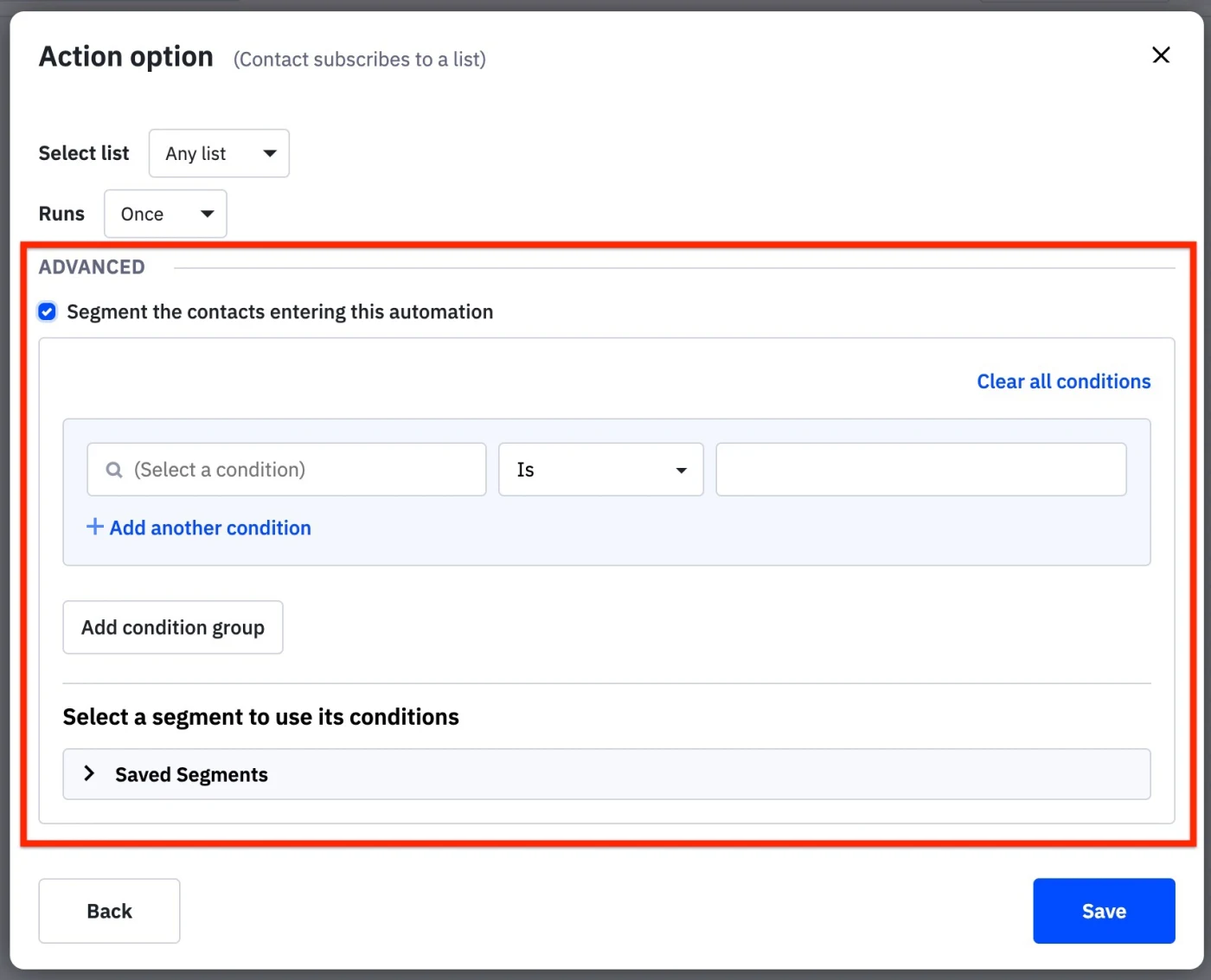
ActiveCampaign requires an “Abandons cart” trigger and an “Abandoned cart” block in a compatible automated campaign. Its documentation excludes that block from direct campaigns.
The abandoned-cart guide develops the recovery content. During implementation, first identify what actually generates the event. Adding an item, starting checkout and leaving a purchase unfinished should not be assumed equivalent without checking the data.
Test one product, multiple products and an item that becomes unavailable. Review name, image, price, currency, language and return link. These are proposed journey checks, not a claim that every connector transfers every field.
Define the end as well: subsequent purchase, unsubscribe, message limit or changed context. Test a second abandonment to decide whether re-entry is appropriate. Recovery should not become indefinite reminders about the same attempt.
A test matrix the team can repeat
Validate with controlled contacts and fictional data, avoiding test sends to real buyers. Record version, expected outcome, observed outcome and the person responsible for fixing each failure. A reviewed checkbox should refer to a concrete check.
These cases cover common decisions; add cases specific to the catalogue and integrations:
- An eligible person enters and an ineligible person stays out.
- An unsubscribe during a wait prevents the next marketing message.
- A purchase during the sequence changes the journey according to the intended rule.
- A duplicate event does not produce duplicate communications.
- An empty field leaves an understandable greeting and message.
- Links reach the correct destination and retain the context needed to buy.
- Overlapping automations respect the agreed priority.
- Pausing and resuming has a known effect on people waiting in the journey.
- The team can identify the active version and its content approver.
Maintain the system and distinguish attribution from impact
Keep an inventory of automations, fields, tags, lists, forms and integrations with their dependencies. Before deleting or renaming something, check which conditions use it. Repeat affected cases after connector or checkout changes. Documentation should let someone else continue the work.
Separate initial setup, copy, design, revisions and monitoring in the budget. Confirm plan limits, third-party costs and incident-handling capacity. Do not promise an activation date without knowing which access and data are available.
Agree definitions and comparable periods when interpreting results. The email metrics guide distinguishes sends, interaction, orders and attribution. A purchase associated with an email does not alone demonstrate an additional sale; include returns, unsubscribes and costs.
If messages are not reaching recipients, examine deliverability before multiplying branches. Improvements should respond to an observed limitation and a subsequent test, not a desire for a more complicated journey.
Sources and further reading
AI-assisted translation
Article by Dídac Anton. The English, German, Dutch and French versions were translated from Spanish with the help of AI.
Read the Spanish originalRecommended articles

Shopify email marketing agency
Connect Shopify to an email strategy with validated data, markets and automations before launch.

Ecommerce email marketing guide
A practical ecommerce email guide: what to build first, how the pieces connect and what to measure at each stage.
Abandoned cart email sequence
Examples, logic and decisions for a relevant, measurable abandoned cart sequence that does not always rely on discounts.